Austin, TX

Commercial Garage Door Repair Across the Austin Service Area

Commercial garage door repair and service for Austin, TX businesses: spring, opener, track, and panel repair with straight, upfront pricing and quick calls.

Commercial Garage Door Repair Across the Austin Service Area in Austin
Same-day service in most cases
Serving Austin, TXBackground-checked techsHonest, upfront pricingFast local response
Local
Crews that work this area daily
Same-day
Response for most repair calls
Upfront
Pricing agreed before we start
Insured
Background-checked technicians

Booking

Booking a Visit

Commercial garage door calls don't run like residential ones - a dock stuck open at 6 a.m. can shut down a warehouse or storefront outright. Here's what happens when you call and how we sequence a commercial visit around your operating hours instead of ours.

  1. Describe what the door is doing

    A dock door stuck open at 6 a.m. isn't a homeowner's inconvenience - it's a warehouse that can't load trucks or a storefront that can't roll up its gate. Tell us what the door is doing, what it's attached to (a dock leveler, sensor loop, keypad, or chain hoist), and whether the building can operate at all with it down; that's what decides how we sequence the day.

  2. We schedule around your hours

    We schedule around your operating hours where we can, rather than the other way around - a restaurant kitchen bay and an office park's rear dock don't share the same downtime tolerance, so we ask up front instead of guessing. That's true whether you're running a single storefront gate or a warehouse with multiple dock doors.

  3. We flag parts that need ordering

    If a part has to be ordered rather than pulled straight off the truck, we say so before we roll a second truck out for nothing. That's especially true on commercial hardware - certain drum sizes, gear kits, or heavy-duty springs - where guessing wastes your time and ours.

  4. We match the job to the right tech

    We don't run same-hour emergency dispatch on every job type - a snapped cable on a 400-lb steel door needs a tech who's handled that repair before, not just whoever's closest. If your account needs a standing service agreement or recurring inspection, that's a conversation for the visit itself, not something we quote blind over the phone; for everything else we handle, see the home page.

Local causes

Why This Fails Locally

Austin sits in a HEAT moderate climate band, and that's the actual driver behind most of the commercial door calls we take, not age or neglect. Steel track, torsion springs, and aluminum panel skins all expand and contract with the daily swing between a cold predawn dock and a metal building baking by early afternoon. That cycle loosens track bolts, throws photo-eye sensors out of alignment by a few degrees, and fatigues torsion springs faster than their rated cycle count suggests they should fail.

On a residential door that shift is a nuisance. On a commercial door - heavier, cycled dozens of times a day by delivery trucks or forklifts - the same expansion turns into binding, and a binding door under a chain hoist strains the opener motor until it either stalls or burns out.

We also see it show up as intermittent faults: a door that closes fine at 7 a.m. and refuses to seat by 2 p.m. That's not a bad opener, that's steel that's a few millimeters longer than it was six hours earlier, catching a roller on a track that was set true when it was cooler. It's a climate problem wearing an equipment complaint's clothes.
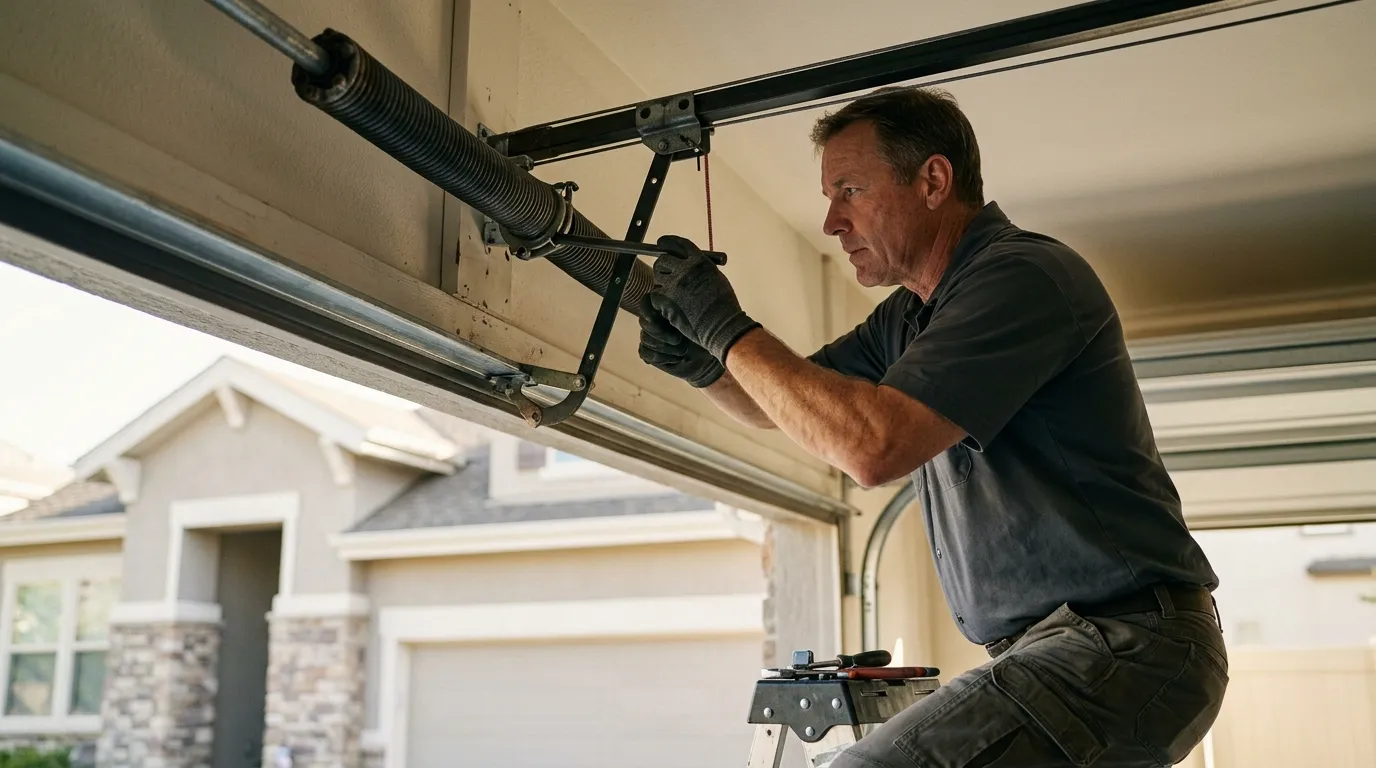
Why This Fails Locally

Warning signs

What You Are Seeing

The most common commercial call is a door that reverses partway through closing, and from there the faults follow a predictable pattern tied to heat cycling and cycle count. Here's what we see most often on commercial doors across the Austin service area, from sensor faults to worn hardware.

Door reverses partway closing

The most common commercial call is a door that reverses partway through closing - usually a sensor knocked out of true by the daily heat cycle, or a track bolt that's worked loose enough to flex under the door's own weight. Either fault traces back to the same expansion-and-contraction cycle that affects steel track and panel skins across the service area.

Torsion spring losing tension gradually

The second most common fault is a torsion spring that's lost tension gradually rather than snapping outright, so the door feels heavier every week until the opener starts straining to lift it, then finally trips its overload protection. That slow decline is easy to miss until the opener can't compensate anymore.

Roller and hinge wear from cycle count

On heavier commercial sections - steel-clad, insulated, or oversized dock doors - we also see roller and hinge wear that residential doors rarely reach, simply from cycle count. A door that opens forty times a day wears its hardware on a completely different schedule than one that opens twice.

Cable fray and stripped opener gears

Less common but real: cable fray on doors with worn drums, and opener gear-sets stripped from being run against a door that was already binding on a bad track. Most of the burned-out openers we replace didn't fail on their own - they failed pushing against a mechanical problem nobody fixed first, so a tripping opener is almost never solved by a new opener alone.

Pricing

What You Pay

We don't post flat commercial rates, and we won't quote one over the phone sight-unseen - a torsion spring swap on a 9-ft steel door and a full track realignment on a 16-ft insulated dock door aren't the same job. Here's what actually drives the number once a tech is on site.

Repair vs. replacement decision

Across the Austin service area, median household income runs $121,750, and that shows up in how commercial accounts decide between repair and replacement - a full opener or panel replacement gets chosen more often here than a patched fix that'll need revisiting in a year.

Parts we don't stock on the truck

Some commercial hardware - certain drum sizes, specific opener gear kits, heavy-duty torsion springs for oversized doors - isn't something we stock on the truck. If your door needs a part like that, the visit becomes a diagnosis and a quote, with a second trip once the part's in; we'd rather tell you that up front than have you wait on-site for a part that's three days out.

A written number before we start

Whatever the job, you get a written number before we touch the door, not after, so a torsion spring swap on a small steel door and a full track realignment on a large insulated dock door are each priced on what they actually need, not a one-size guess.

Questions

Common questions

Do you work on dock doors and warehouse doors, not just storefront gates?

Yes - dock doors, roll-up steel doors, insulated warehouse sections, and standard commercial storefront gates all fall under the same service. The mechanics differ by weight and cycle count, but the diagnosis process is the same: find what's actually binding or worn before replacing anything.

Why does our door only act up in the afternoon?

That's almost always heat expansion. Austin's climate band pushes steel track and panel through daily temperature swings that can throw a sensor or tighten a roller against a track just enough to cause an intermittent fault. It usually isn't the opener - it's the metal around it changing shape by a few millimeters as the day heats up.

Can you give us a same-day quote over the phone?

Not a firm one. Commercial doors vary too much by size, weight, and hardware for a phone estimate to mean anything. We'll give you a written number after a tech has looked at the actual door, spring, and opener in person - that's the only quote we'll stand behind.

Ready when you are

Need a garage door sorted in Austin?

Austin Garage Door Guys repairs and installs garage doors, springs and openers in Austin, TX and the surrounding area.

CallGet a quote