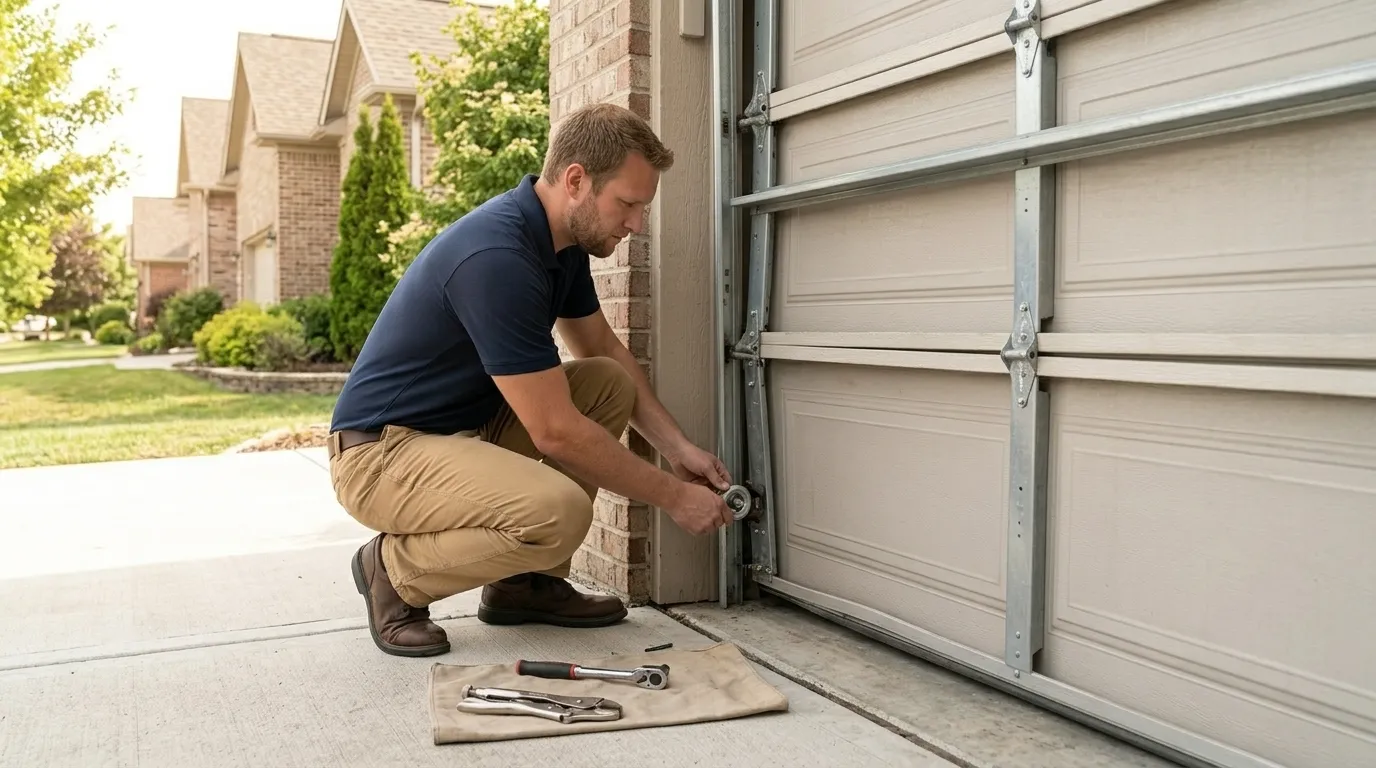
Is Your Austin Garage Door Worth Fixing, or Time to Replace It
Austin's housing stock runs 1980 to 2014, mostly 1980s-90s builds. Here's how that age and Austin heat decide whether your door is worth repairing or replacing.
Most of the houses we work on around Austin went up between 1980 and 2014, with the bulk of that stock dating to the 1980s and 90s. That matters because a door installed when the house was built is now anywhere from 10 to 45 years old, and the hardware standards changed more than once in that window. A door from a 1988 build often runs on a lighter torsion spring than what we'd spec today, and the galvanized coating on older track wasn't built for the number of 100-plus degree days Austin gets most summers. Heat here is moderate on the federal climate band, but moderate still means steady thermal cycling on steel and vinyl seals, year after year, and that cycling is what dries out rollers and cracks bottom seals long before the opener itself quits. A door that's spent 25 summers in an unshaded Austin driveway has taken more heat stress than the same door would in a cooler climate, even without a single storm involved. That's the baseline we're working from before we ever look at a specific complaint.
When to Call Someone
Call when a door that used to open quiet starts grinding, when a panel is visibly bent, or when the door reverses on its own partway down. Don't wait on a spring that's already snapped - a broken torsion spring on a heavier insulated door, common in houses built after the mid-1990s, can let the door slam if someone tries to force it by hand. If your opener is original to a 1980s or 90s build, the drive gear and capacitor are past their design life regardless of how the door looks, and a failing capacitor shows up as a motor that hums but doesn't lift. One honest note: if the only symptom is noise and the door still opens and closes on the first try, that's usually a lubrication and hardware-tightening job, not a service call worth scheduling same-day.
The Situation
Across the Austin area, roughly 41,792 of the 73,657 households are owner-occupied, and a lot of that owned housing sits in the same 1980-2014 build window. That means a large share of the doors we see aren't failing from one bad event - they're failing from age doing what age does to steel, springs, and seals over two or three decades of Austin summers. In neighborhoods closer in, like Tarrytown, Rosedale, or Zilker, homes tend to run older within that range, so original hardware is more common. Farther out toward Steiner Ranch or Wells Branch, builds skew newer, closer to the 1998 median, which usually means the opener is the weak point rather than the door panel itself. Neither case means automatic replacement. A steel door with intact panels and a bent track is a repair. A door with rusted-through panel skin, delaminated insulation, or an opener that's already been rebuilt once is usually not worth a second repair.
What You Pay
We don't have a fixed price list to quote here, and giving you a number without seeing the door would be a guess dressed up as a fact. What we can tell you is how we think about it: a torsion spring swap or a section of new track is almost always cheaper than a full door, and on a well-built door from the 1980-2014 window, that hardware is often the only thing that's actually worn out. Where the math flips is when the door itself has failed - rusted bottom panels, warped sections from years of sun on an unshaded west-facing garage - because at that point you're paying repair money toward a door that still won't look or seal right afterward. Median household income across our service area runs around $121,750, and most homeowners in that range end up choosing full replacement once two separate repairs on the same aging door start stacking up, rather than a third call for a different failure.
How it works
From “it’s stuck” to “it’s fixed”
01
Tell us what’s wrong
Describe the symptom - won’t open, loud bang, opener runs but the door won’t move.
02
On-site diagnosis
A technician tests the door under power and by hand and finds what actually failed.
03
Clear, up-front plan
You get the fix that’s needed and what drives the cost - before any work starts.
04
Repaired & tested
The repair is done, the door is set true and tested, and the work area left clean.
Serving Austin, TX - call 17374360211 or request a quote online.
My garage door is from the original 1990s build of my house. Is it too old to fix?
Not automatically. If the panels are straight and rust-free, a 1990s door can often take a new spring, cable, or roller set and run fine for years more. Age alone doesn't disqualify it - what matters is whether the steel and insulation have held up, which varies a lot house to house.
Does Austin heat actually wear out garage doors faster?
Austin sits in a moderate heat band, but that still means steady expansion and contraction on steel track and rubber seals across long, hot stretches. Over 20-plus years that cycling dries seals and can warp thinner door panels, especially on unshaded, west-facing garages, more than a single extreme event would.
How do I know if it's the opener or the door that's failing?
If the door moves smoothly by hand but the opener struggles, hums, or stalls, the opener is usually the problem, common on original units from 1980s-90s builds. If the door itself binds, sags, or won't sit flush even disconnected from the opener, that points to the door or track.
Ready to get your garage door sorted?
Tell us what it’s doing and where you are in Austin - we’ll take it from there.