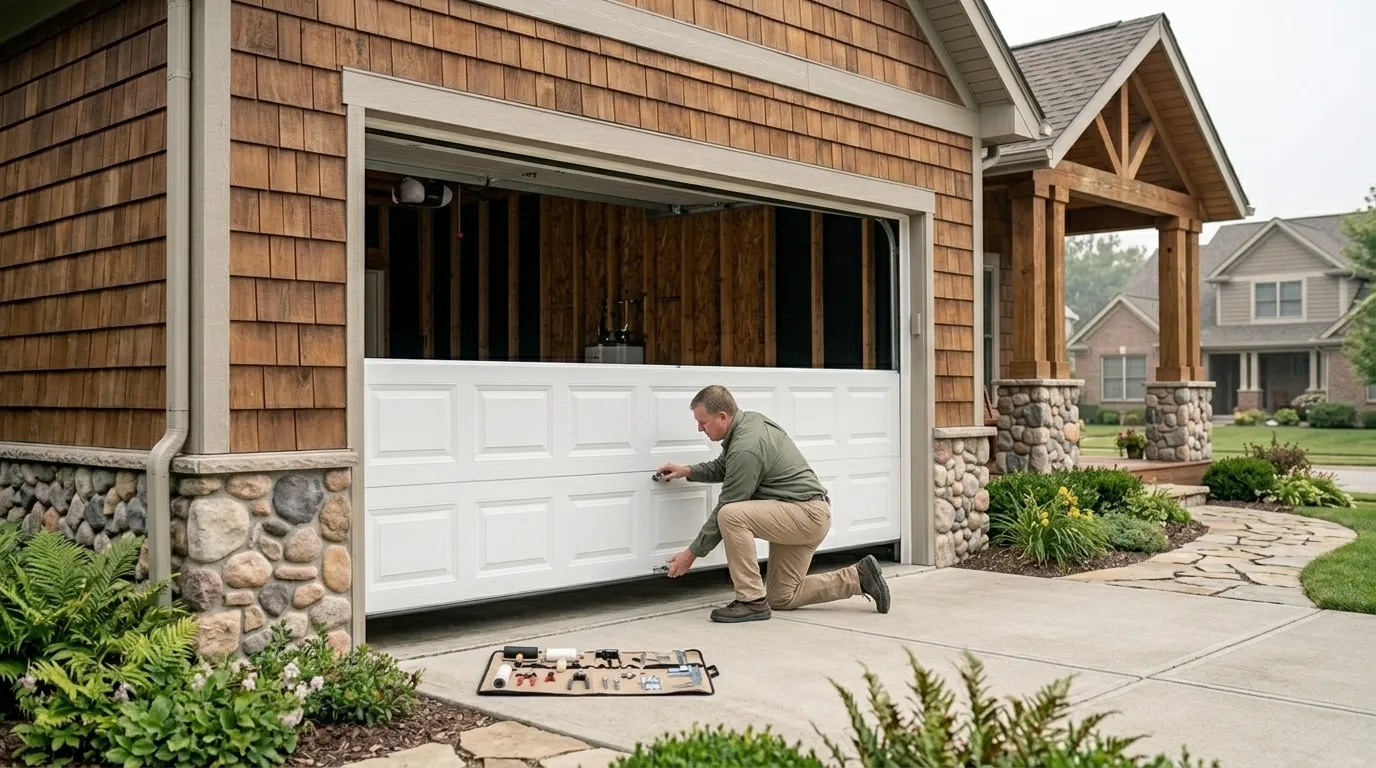
Why So Many Austin Garage Doors Predate Insulation Standards
Most Austin garage doors date to 1980-2014, before insulated panels were standard, meaning real heat, upkeep, repair issues in homes built during that era.
Most of the housing across this service area went up between 1980 and 2014, with a median build year of 1998. That matters more than people think, because insulated garage door panels didn't become the default option builders reached for until well after that median date. A door built to spec in, say, 1996 is almost always a single layer of steel or aluminum over an open cavity - no polystyrene, no polyurethane core, nothing between your garage and the outside air.
Austin sits in a moderate-heat climate band, and an uninsulated door is the single largest thermal opening most attached garages have. In the afternoon that steel skin absorbs heat directly, and if the garage shares a wall with a bedroom or laundry room, you feel it inside the house, not just in the garage. Across the 23 named communities we track in this area - Tarrytown, Rosedale, Allandale, Zilker, Bouldin Creek, and the rest - the stock skews the same way: 1980s and 90s construction, same door technology, same gap.
This isn't a defect. It's just what a door from that era was built with. The fix is a known one - swap the panel section, not necessarily the whole opener or track - but it only makes sense once you know which decade your door actually came from.
When to Call Someone
Call when the garage itself runs noticeably hotter than the rest of the house, especially in a room that shares a wall with it. That's usually not the opener or the springs - it's the door skin doing exactly what an uninsulated steel panel from the 1980s or 90s does in a moderate-heat climate. You can put a hand flat on the inside of the door in the afternoon and feel it.
Call sooner if you see daylight around the edges of a closed door, or if weatherstripping at the bottom has cracked and pulled away from the track. Those gaps let conditioned air out and heat in regardless of what the panel itself is made of, and they're a five-minute fix compared to a full panel swap.
Don't call about insulation if the door is already sagging, the panels are visibly bowed, or the springs are original to a house built in the median 1998 range - at that point you're not retrofitting insulation into an aging door, you're replacing a door that's near the end of its service life anyway. We'll tell you which situation you're in before we quote anything, because insulating a door that needs replacing in two years isn't worth your money.
The Situation
This service area covers 73,657 households, with 41,792 of those in owner-occupied houses - the group that actually decides whether a door gets insulated or not, since a landlord rarely spends on comfort upgrades a tenant won't ask for by name. Median household income here runs $121,750, which is enough to make a full panel replacement a real option rather than a stretch, but it doesn't change what decade your house was built in.
The geography matters too. Close-in neighborhoods like Tarrytown (1 mile west), Rosedale (1 mile north-northeast), Old West Austin (2 miles south-southwest), and Zilker (3 miles south-southwest) sit inside the same 1980s-through-2014 build window as the rest of the tracked area, just closer to downtown. Farther out - Steiner Ranch at 10 miles, Wells Branch at 11, Pflugerville at 14 - the construction dates follow the same pattern. The insulation gap isn't a neighborhood problem. It's an era problem, and the era covers almost this entire service area.
What You Pay
We don't have a flat number to post here, and I'm not going to make one up. What a panel swap or a full insulated replacement costs depends on the door's current size, whether the track and opener are original to a 1990s install or already replaced, and how many panels have the actual damage versus just the age. A one-panel spot fix and a full-door swap on a double-wide are not the same job.
What I can tell you is what drives the number up or down: original hardware from the 1980s-2014 build window is often non-standard sizing compared to what's stocked today, so a straight panel-for-panel match sometimes isn't possible and the whole door gets replaced instead of patched. That's the honest limitation - we can't always match an old panel, and telling you otherwise before we've looked at the door would just be a guess dressed up as a quote. We'll give you a real number after we see what's actually on the wall.
How it works
From “it’s stuck” to “it’s fixed”
01
Tell us what’s wrong
Describe the symptom - won’t open, loud bang, opener runs but the door won’t move.
02
On-site diagnosis
A technician tests the door under power and by hand and finds what actually failed.
03
Clear, up-front plan
You get the fix that’s needed and what drives the cost - before any work starts.
04
Repaired & tested
The repair is done, the door is set true and tested, and the work area left clean.
Serving Austin, TX - call 17374360211 or request a quote online.
Is my garage door original to the house if it was built in the 1990s?
It's likely, though not certain - plenty of owners have already swapped a panel or the whole door since. Given the median build year of 1998 across this area, an original door from that window is almost always uninsulated steel, which is worth checking if your garage runs hot in the afternoon.
Can you add insulation to my existing door instead of replacing it?
Sometimes, if the panel structure allows a foam-board retrofit kit. It works best on flat steel panels typical of 1980s-2014 construction. If the panels are already warped or the door is near the end of its life, retrofitting isn't worth the labor - full replacement makes more sense at that point.
Why does my attached garage feel hotter than the rest of the house?
An uninsulated steel door absorbs afternoon heat directly, and in Austin's moderate-heat climate that heat radiates into any room sharing a wall with the garage. Doors built before insulated panels were standard - most of the 1980-2014 stock in this area - don't block that transfer.
Do you serve neighborhoods outside central Austin?
Yes, this service area runs from close-in spots like Tarrytown and Rosedale a mile or two out to farther communities such as Steiner Ranch, Pflugerville, and Lago Vista. Distance changes scheduling, not whether we'll take the call.
Ready to get your garage door sorted?
Tell us what it’s doing and where you are in Austin - we’ll take it from there.